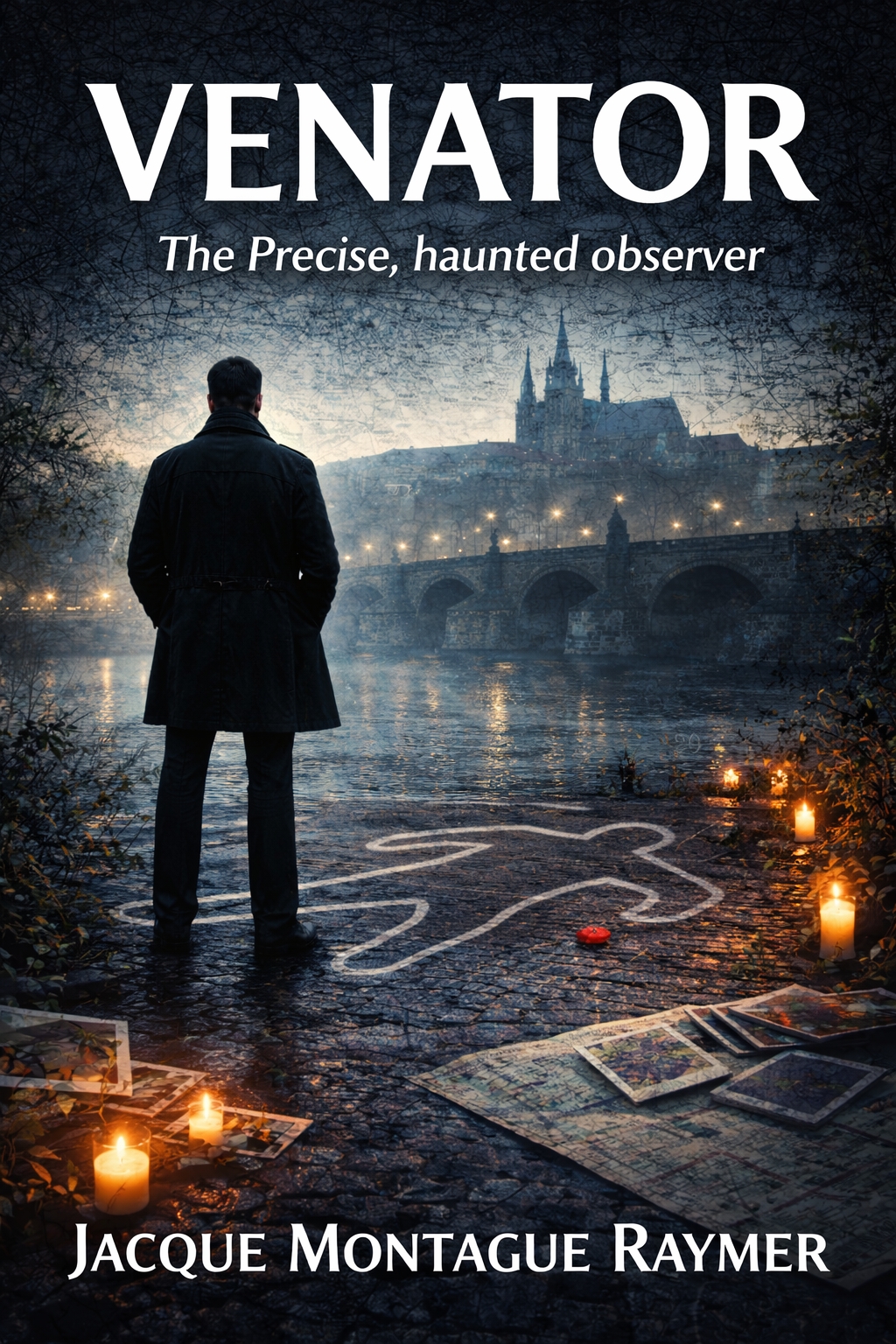
Dark Literary Crime Fiction
Eight Cases · Twelve Years · One Man Decomposing and Reassembling
A forensic behavioral analyst of near-mythic reputation. Eight cases of extraordinary evil across twelve years and six continents. A man studying the line between investigator and monster — unsure, sometimes, which side of it he stands on.
The Detective
He is not a private detective. Not a consultant in the comfortable sense. He occupies a strange jurisdictional space — called when official resources have failed, when a case requires someone unbounded by institutional protocol, or when the stakes are high enough that someone with access decides to buy the best available mind.
Bram Vael was born in Antwerp, Belgium in 1968. His father was a forensic accountant who communicated more through arrangement than language. His mother was a concert-level pianist who stopped playing after an injury when Bram was six. The piano was sold when he was twelve, without discussion. He never forgot that — the way something enormous can vanish from a life and nobody names it.
He studied criminology and psychology at KU Leuven, then completed a postgraduate fellowship in forensic psychopathology at the Vrije Universiteit Amsterdam, where he wrote a thesis on what he called "behavioral archaeology" — the reconstruction of a criminal's internal landscape through the physical evidence they leave. His supervising professor described him as "the one who understood before anyone else that the crime scene is a self-portrait. Everything a killer does is autobiographical."
He joined the Belgian Federal Police in 1993, transferred to Europol's behavioral analysis division in 1994, and spent eight years working cases across Western and Central Europe. He resigned in January 2002 after an institutional failure that cost a third person their life — a case he had solved correctly, documented precisely, and been ignored on. He left a single A4 page on his superior's desk. He has never worked inside an institution since.
"He's the best I've ever worked with. He makes everyone around him feel slightly criminal for not being as good. I wouldn't want to be in the same room with him if I'd ever done anything I wasn't proud of."
— A Europol liaison, 2004He speaks Dutch, French, and German natively. English fluently. Working Spanish and Thai. Fragments of Russian he has never fully accounted for. He lives in Antwerp, in a third-floor flat in the Zurenborg neighborhood — a place of ornate art nouveau facades and quiet streets. The flat is sparse. Books everywhere, in no particular order. A good record player. A single quality armchair. A kitchen he uses for coffee.
He is 34 years old when the series begins in 2002, and 46 when it ends in 2014. What happens between those two numbers is the subject of eight books.
Known Vices
The Rules He Never Breaks
Rules Others Find Strange
The Central Wound
"Is there anything fundamentally different between me and the people I study?"
— The question organizing Vael's life, never spoken directlyHe is brilliant at modeling evil. He understands predatory behavior better than almost anyone alive. He has, on at least two occasions, found himself in a state that could be described as admiration — not for the harm, but for the architecture. He has never acted on it. He doesn't believe he would. But he is not entirely certain.
That uncertainty is what keeps him honest. And what keeps him awake.
Eight cases, across twelve years, will force him to that question from eight different angles. Each villain will hold up a different mirror. The answer, when it finally comes in Book 8, is not reassuring. It is honest. And the series earns it.
How He Works
Vael does not solve crimes through forensics alone. He reads the crime scene as a psychological text — working backward from outcome to cause, finding the specific decision points and internal triggers that produced the evidence in front of him. He calls this process behavioral archaeology.
What Makes Him Exceptional
The Chaos Doctrine
The Venator series operates on a foundational rule: real investigations are recursive, damaging, and uncertain. They do not unfold as a clean 12-step journey from crime to arrest. Good evidence gets contaminated. Witnesses change their stories. Informants go dark. Leads die. Local police resent outsiders. Governments bury things. Money protects people it shouldn't.
In every case, Vael will follow a lead that turns out to be wrong — and that wrong lead will cost him chapters of progress. A witness or source will die or disappear before the case is closed. The villain will have a head start Vael can never fully close. The solution, when it comes, will feel earned and imperfect — not triumphant. Something will be left unresolved. A question he cannot answer. A person he couldn't save.
Every case costs something. Sleep, relationships, certainty, identity. This is not a procedural in which the detective emerges unchanged. Vael accumulates damage across twelve years, and a careful reader notices.
Eight Books
Each book is engineered to function as a complete, self-contained reading experience. No required reading order. No cliffhangers. Every case resolves within its own volume. Cross-book continuity is invisible to a casual reader — and reveals itself, layer by layer, only to someone reading all eight.
The Eight Antagonists
The Venator series argues that evil is not a category but a spectrum of fundamentally different human choices, pathologies, and architectures. Each book's antagonist represents an irreducibly different form — psychologically, operationally, philosophically. No two VENATOR villains are alike at the root. Each one asks the reader a question that does not have a clean answer.
Geography & Atmosphere
Venator is global. Each case plants itself in a specific part of the world and draws deeply from that location's culture, geography, and particular darkness. Geography is a character. Every city, building, road, and room shapes how the investigation feels — and how it ends.
"In this series, weather and geography press on the investigation. The physical world is not backdrop. The cold of Prague in Book 1 is part of the evil. The jungle heat of Thailand rearranges how you think. The volcanic silence of Iceland sticks to the walls. The bayou marsh of Louisiana gives the killer an advantage the investigator can never fully close. Every location has been chosen because the evil belongs there."
— Series World BibleTone & Atmosphere
Venator draws from three core influences without copying any of them. From The Sinner: the idea that evil is not born but constructed, that the most disturbing questions are not who did it, but why. From True Detective: the idea that the world is dirty and old, that evil is cyclical, institutional, geographic, that the investigator himself is a broken man in a broken world trying to hold shape. From Sherlock Holmes: razor-edged deductive reasoning, the outsider analyst who sees what others cannot, the theatricality of intelligence, the loneliness of being different.
And then it adds: genuine geographic scope. The chaos doctrine. Real investigative cost. The series is written in dense, precise prose. Short declarative sentences at tension peaks. Longer, humid sentences in reflection. These are literary novels that happen to be about crime.
The World Feels
What Venator Is NOT
The People Around Him
Vael does not work in a team. He works alone, through, and occasionally against the people around him. But certain figures recur — some by design, some by the accumulated weight of years. Each carries their own history, their own loyalties, and their own costs.
Director Vera Stael
Vera Annikki Stael is officially the Senior Coordinator of the European Security Integration Liaison — an organization that appears in no public directory, has no website, and is treated by national intelligence agencies as existing somewhere between a clearing house and an authority with no formal mandate but real access.
She is 52 when Book 1 begins, 64 when Book 8 ends. White hair since her mid-40s — she did not dye it when it turned. A choice. She has been doing this kind of work, in various forms, for approximately 25 years when the series opens. She speaks eight languages. None of them won.
She facilitates at least four of Vael's cases. She clears scenes before local police arrive. She has a past with him he has never explained to anyone, including himself. Whether she represents something that protects Vael or something that uses him is a question the series distributes across eight books without answering cleanly.
Local Partners — By Book
Each book introduces a primary local partner — the person already on the ground when Vael arrives. These are investigators, police officers, forensic specialists, community members. They are never simply functional. They complicate the work, offer knowledge Vael can't have, and carry the weight of whatever comes after he leaves. They are the series' consistent argument that Vael's method is incomplete without people who belong to the place he is investigating.
The Hidden Architecture
These four connecting elements are present across all eight books in faint, distributed form. They are never answered explicitly. They are for the reader who reads all eight to piece together. A casual reader will not see them. A careful reader will. Both experiences are valid. Both are the intended experience.
The Invisible Spine
This is the arc that connects the series without being explicitly stated in any single book. Each volume contributes to it while remaining entirely standalone. A reader who only reads Book 5 gets a complete story. A reader who reads all eight gets this — the slow decomposition and reassembly of a man across twelve years.
Vael's Accumulated Damage
The Philosophical Architecture
"Yes, there is a difference. The difference is a choice I made. The choice is repeatable. It has not always been easy. It will not always be easy. There is no guarantee. But the practice of choosing correctly — maintained, tested, paid for — is what I am."
— Vael's answer, Book 8Venator is not, at its core, about crime. It is about the question Bram Vael has been asking since he was a young criminologist and has never fully answered: what is the distance between a person who studies evil and a person who enacts it?
Each of the eight books approaches this question from a different angle — using a different type of villain, a different type of harm, a different part of the world, and a different aspect of Vael's psychology. The cases are designed to be standalone. The philosophical architecture is designed to be cumulative. A reader who does all eight will arrive at Book 8's confrontation having been prepared, in eight specific ways, for the question it asks.
The series' answer is not reassuring. It is honest. Vael earns it across twelve years. So does the reader.